Product Knowledge
Process Flow of Metal ore Crushing Plant
author:dahua2 time:2026-11-13
Metal mines are operations primarily focused on the extraction of metallic minerals—such as iron, copper, tungsten, gold, and lead-zinc—serving as the essential source of raw materials for industries like metallurgy and high-end equipment manufacturing. A standardized metal ore crushing production line is built upon core industry principles: "maximize crushing, minimize grinding; discard waste early; and achieve staged mineral liberation." Through four key processes—primary crushing, secondary/tertiary crushing, screening/classification, and grinding/beneficiation—large, run-of-mine ore is progressively processed until the minerals are sufficiently liberated and reduced to the required particle size, creating the necessary conditions for subsequent separation and enrichment to produce high-grade metal concentrates.
1. Raw Ore Transport and Primary Crushing
Large, run-of-mine ore is transported by dump trucks and discharged into a receiving hopper. A heavy-duty vibrating feeder, positioned beneath the hopper, ensures a uniform and continuous flow of material into the primary crushing equipment. The core machinery at this stage is typically a heavy-duty jaw crusher or a large-scale gyratory crusher. Utilizing the principle of inter-particle (lamination) crushing, these machines reduce raw ore—which may exceed 1 meter in size—to less than 300 mm. The choice of equipment depends on the scale of the mining operation; large-scale metal mines with annual processing capacities in the tens of millions of tonnes typically favor gyratory crushers for primary crushing.
2. Secondary/Tertiary Crushing and Closed-Circuit Screening
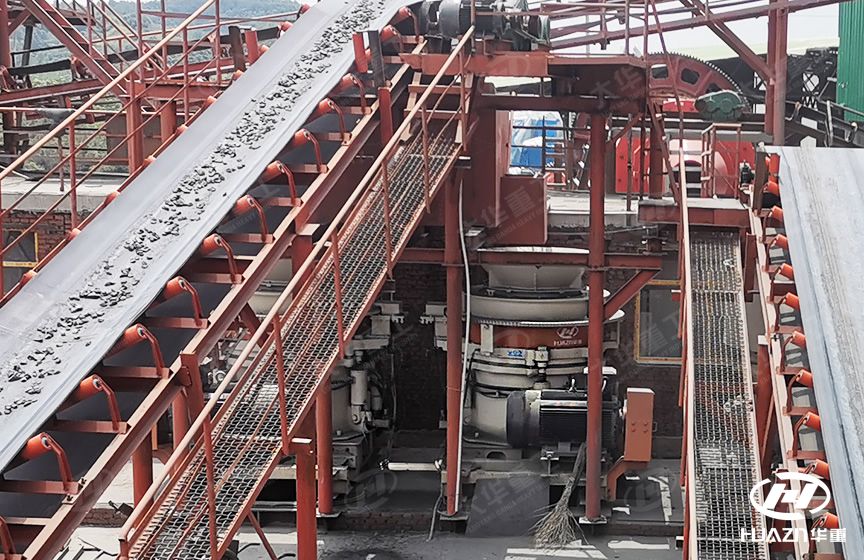
Following primary crushing, the ore is transported via enclosed belt conveyors to the secondary and tertiary crushing facility. It first passes through a heavy-duty grizzly vibrating screen for preliminary sizing; the undersize (fines) proceeds directly to the next stage, while the oversize (coarse material) is fed into a standard hydraulic cone crusher for secondary crushing. The product from this stage then enters a short-head hydraulic cone crusher for tertiary crushing. The finely crushed material is returned via belt conveyor to a multi-deck circular vibrating screen, creating a closed-circuit loop. This ensures the final product particle size is strictly controlled—typically within 10–15 mm—meeting the specific requirements for the subsequent grinding process. For some high-hardness metal mines, a high-pressure grinding roll (HPGR) is incorporated after the fine-crushing stage. This utilizes inter-particle (bed) compression to further reduce the feed size for the downstream grinding circuit, while simultaneously inducing a high density of micro-cracks within the ore, which significantly enhances the efficiency of the subsequent grinding process.
3. Grinding and Classification Stage
Material that meets the size specifications after screening is transported via a conveyor system to the grinding plant. Common configurations include the SAB (Semi-Autogenous Grinding + Ball Mill) circuit, or a two-stage grinding circuit consisting of a grate-discharge ball mill followed by an overflow-type ball mill. The ground product, in the form of a slurry, is fed into a hydrocyclone cluster for classification. The fine-grained overflow—meeting the required size—proceeds to the downstream beneficiation stages, while the coarse-grained underflow is returned to the ball mill for further grinding. This creates a closed-circuit grinding process, ensuring the final feed size remains consistently within the range required for optimal mineral liberation.
4. Beneficiation and Auxiliary Control Stage
Following grinding and classification, the slurry is processed using equipment tailored to the specific characteristics of the metal minerals. Magnetite-type ores are processed using wet drum magnetic separators, while complex polymetallic ores—containing gold, copper, lead, and zinc—are enriched and purified via the use of mechanical (agitated and aerated) flotation cells. In cases involving fine-grained or refractory minerals, vertical-ring high-gradient magnetic separators may also be employed to improve recovery rates. The entire production line is integrated with a Distributed Control System (DCS), which monitors operational parameters—such as motor current, bearing temperature, and equipment vibration—in real time. This enables one-touch start/stop functionality and automated fault alerts; some "smart mines" have even achieved fully unmanned operation in their crushing sections.
As the primary core stage of the mineral processing workflow, the configuration of a metal ore crushing production line directly dictates downstream grinding energy consumption, metal recovery rates, and overall production stability. As a specialized equipment manufacturer deeply rooted in the mining crushing sector, Dahua Heavy Industry offers a comprehensive range of solutions tailored to the specific requirements of metal mines—accommodating varying ore hardness levels and production capacities. Our portfolio spans primary crushing equipment (gyratory and jaw crushers) to secondary and tertiary crushing (cone crushers), as well as screening and grinding machinery. Leveraging our proprietary intelligent operation and maintenance system, combined with extensive experience in full-process EPC (Engineering, Procurement, and Construction) contracting, we assist mining clients in developing modern, highly stable, and energy-efficient crushing production lines, thereby laying a solid foundation for the high-efficiency operation of the entire downstream mineral processing workflow.
Previous Article:No Information
Next Article: Types of Mobile Sand-Making Machines