Product Knowledge
Tungsten Ore Crushing and Screening Process
author:dahua2 time:2026-10-15
Tungsten is a critical strategic metal that underpins high-end manufacturing and military equipment. Naturally occurring tungsten ore is not only low-grade but also typically exists as large chunks, intimately associated with gangue minerals. The objective of mineral processing is to enrich the ore—using physical or chemical methods—to produce a tungsten concentrate containing 60%–70% tungsten trioxide. The overall tungsten beneficiation process consists of three main stages: pre-processing, separation, and dewatering. Tungsten Ore crushing and screening as the core components of the pre-processing stage, serve to gradually reduce the size of large raw ore chunks to a range suitable for downstream operations. This prevents excessive loads on subsequent grinding circuits while minimizing the over-grinding and "sliming" (formation of ultra-fine particles) of brittle tungsten minerals, thereby establishing the necessary conditions for the effective liberation of individual mineral grains during grinding and classification. Depending on the scale of production, the industry typically employs configurations such as single-stage or two-stage closed-circuit systems, utilizing key equipment including jaw crushers, cone crushers, and vibrating screens.
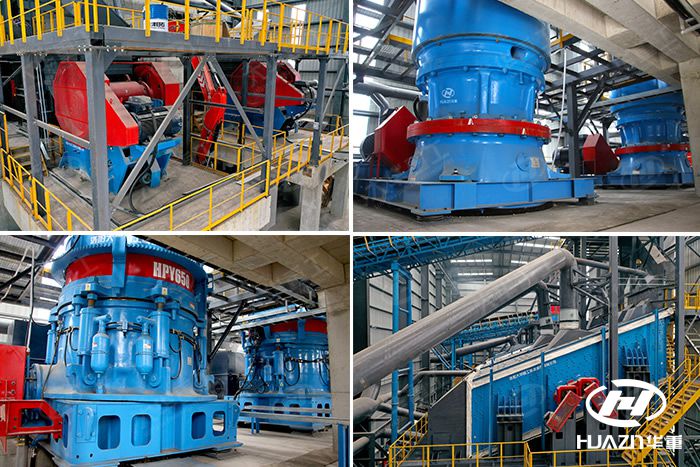
A complete tungsten ore crushing and screening process comprises four core stages, each with specific equipment and operational objectives:
1. Primary Crushing
Large, run-of-mine tungsten ore chunks (300–500 mm) are fed uniformly into a jaw crusher via a vibrating grizzly feeder. Through the compressive action of the jaw plates, the ore is reduced to a size range of 100–200 mm. This stage achieves the initial volume reduction of the raw material; the jaw crusher, characterized by high impact resistance, is well-suited for the primary crushing of high-hardness tungsten ore.
2. Secondary Crushing
Following primary crushing, the ore is transported via a belt conveyor to an intermediate surge bin, from which it is fed into a single-cylinder hydraulic cone crusher for secondary size reduction. This process brings the material size down to 25–50 mm. Compared to impact crushers, cone crushers are better suited for the secondary crushing of tungsten ore, as they produce fewer elongated or flaky particles when processing hard rock and experience significantly less wear on crushing components.
3. Closed-Circuit Fine Crushing and Screening Operation
The product from the secondary crushing stage is fed into a multi-cylinder hydraulic cone crusher for further size reduction. The resulting material then enters a circular vibrating screen for classification. Material that passes through the screen (meeting the required particle size) is sent to the ore grinding bin, while coarse particles larger than 12 mm are returned to the fine-crushing cone crusher for further processing. This creates a closed-loop system, ensuring that the final crushed product has a uniform and controllable particle size distribution.
4. Pre-sorting (Waste Rejection) Operation
The screened, appropriately sized ore can be processed using intelligent X-ray sorting equipment to precisely reject low-grade waste rock. This process can achieve a waste rejection rate of 20%–40%, directly reducing the volume of material fed into the subsequent grinding stage and significantly cutting down on energy consumption that would otherwise be wasted during grinding.
Once the properly sized ore enters the grinding and classification stage, a ball mill is typically employed as the primary grinding unit. Through the impact and attrition of steel balls, the ore is ground to the specific particle size range required for mineral separation. By integrating a spiral classifier or a hydrocyclone, a closed-circuit grinding system is established. This setup ensures the full liberation of tungsten minerals from the gangue. Furthermore, by adjusting the grinding pulp density and the steel ball charge (grading), the over-grinding of brittle wolframite can be minimized, providing a stable feed for subsequent gravity separation and flotation processes.
This "crush more, grind less" approach effectively addresses the challenges posed by the high hardness and difficult-to-crush nature of tungsten ore, while simultaneously preventing the over-grinding and "sliming" (excessive production of fine, difficult-to-recover particles) of brittle tungsten minerals. As a critical preliminary stage in the overall tungsten beneficiation flowsheet, this process is essential for ensuring high recovery rates and controlling production costs; it has now become the standard, mainstream configuration for large- and medium-sized tungsten processing plants .
Luoyang Dahua Heavy Industry is a direct-sales manufacturer integrating R&D, production, sales, and service. We offer a wide range of high-quality, reliable mining crushing equipment. We provide customized equipment configurations and operational solutions tailored to your specific process requirements. Our comprehensive services cover everything from equipment selection and site assessment to manufacturing, installation, commissioning, and final handover. We invite you to visit Luoyang Dahua Heavy Industry for an on-site inspection—we are ready to provide you with professional support!
Previous Article:No Information
Next Article: What are the Advantages of Using Cone Crushers for Crushing Granite?