Product Knowledge
What is the Process of a Complete Ore Dressing Production Line?
author:dahua2 time:2026-06-16
In the mineral resource development and utilization process, the ore processing production line is the core industrial system that separates and purifies raw ore to obtain finished concentrates that meet industrial requirements. Based on the physicochemical properties of the ore, it processes it through multiple steps to ultimately separate useful minerals from gangue impurities. It is a crucial link in turning waste into treasure and achieving efficient utilization of mineral resources. A standard mineral processing production line typically includes four main stages: crushing and screening, grinding and classification, beneficiation and purification, and dehydration and drying. Each stage has its specific function, and they work together to complete the mineral processing task.
1. Crushing Stage
The mined raw ore has varying particle sizes. Large pieces of ore cannot directly enter the grinding stage and need to undergo multiple crushing stages, generally divided into three steps: coarse crushing, medium crushing, and fine crushing.
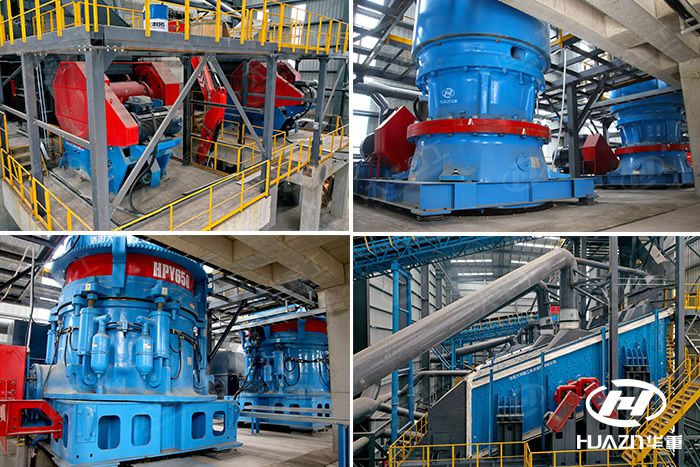
The coarse crushing stage often uses jaw crushers, which can withstand large crushing forces and break large pieces of ore, several meters in size, into fragments of several centimeters. Medium crushing often uses single-cylinder hydraulic cone crushers, which can crush ores of various hardnesses, further reducing the ore to a few centimeters in size. 1. Fine Crushing Stage: A multi-cylinder hydraulic cone crusher can be selected for the fine crushing stage. This equipment, relying on multi-cylinder hydraulic technology and optimized cavity design, offers excellent crushing performance for high-hardness ores. The discharge port size can be precisely adjusted via a PLC intelligent system to stably control the output particle size. The entire crushing process follows the industry principle of "more crushing, less grinding." The application of the multi-cylinder hydraulic cone crusher further reduces the particle size of the ore entering the mill, reducing subsequent grinding energy consumption.
2. Screening Stage
The crushed ore is sent to a vibrating screen for classification and screening. Ore meeting the particle size requirements is separated and sent to the next process. Large pieces of ore that do not meet the requirements are returned to the crusher for re-crushing, forming a "closed-loop cycle." This ensures that the ore entering the next stage has a uniform and stable particle size, laying a good foundation for grinding operations.
3. Grinding Stage
The screened ore is sent to a ball mill for grinding. Inside the ball mill, steel balls continuously impact and grind the ore as the mill rotates, further refining the ore to a single-unit liberation particle size, completely separating gangue minerals from valuable minerals. To improve grinding efficiency and avoid energy waste from over-grinding ore, grinding operations are combined with classification operations: the ground slurry is fed into a hydrocyclone or spiral classifier, where centrifugal force or differences in particle settling velocity are used for classification. Coarse particles that do not meet the size requirements are returned to the ball mill for further grinding, while fine particles that meet the size requirements are sent to the next stage.
4. Beneficiation Stage
Based on the characteristics of the target minerals, appropriate separation methods are selected. For example, magnetic minerals are separated using magnetic separation, non-ferrous metal minerals are mostly separated using flotation, and minerals with large density differences are separated using gravity separation. This separates the valuable minerals from the slurry, yielding a rough concentrate.
5. Dewatering and Drying Stage
The separated concentrate has a high water content. It is first concentrated by sedimentation in a thickener to remove most of the water, then filtered by a filter and dried in a dryer, finally obtaining a dry concentrate product that meets the requirements. The tailings are transported to a tailings dam for storage, and some can be reused to improve resource utilization.
Luoyang Dahua Heavy Machinery is a direct-sales manufacturer integrating R&D, production, sales, and service. We provide various types of mining crushing equipment, offering high quality and reliability. We optimize and combine different models of equipment, tailoring supporting equipment and construction solutions to meet diverse process requirements. We serve you from equipment selection and site inspection to equipment manufacturing, installation, commissioning, and delivery. Welcome to visit Luoyang Dahua Heavy Machinery for on-site inspection and professional support!
Previous Article:No Information
Next Article: How much does a sand and gravel vibrating screen cost?