Product Knowledge
Advantages and Types of Mobile Crushing Plants
author:dahua2 time:2026-04-08
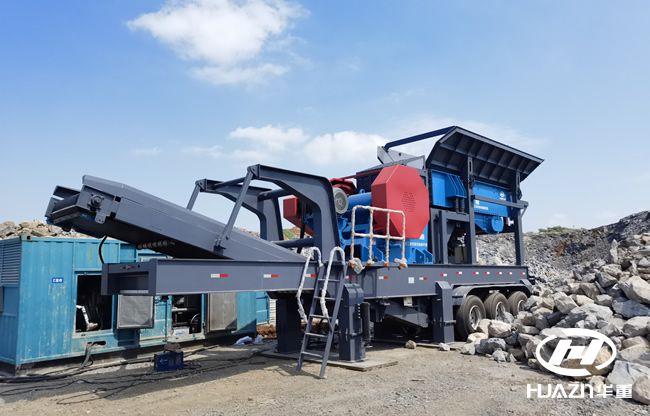
In traditional crushing operations, large pieces of ore mined from mines and construction waste from urban demolitions need to be transported long distances to fixed crushing sites. This is not only time-consuming and labor-intensive but also generates high transportation costs and environmental pollution. The emergence of mobile crushing plants has completely broken this constraint. Like a mobile "crushing factory," it integrates feeding, crushing, screening, and conveying functions, and can be directly deployed to the work site to achieve "on-site processing" of materials.
I. Core Advantages of Mobile Crushing Plants
The success of mobile crushing plants in multiple fields is inseparable from their advanced technological design. Customized main units are their core competitiveness. For different material characteristics, the main unit uses high-strength wear-resistant materials and an optimized crushing chamber design. Taking the jaw crusher main unit as an example, the tooth angles of the moving and fixed jaws have been optimized through dynamic simulation, reducing the probability of material blockage and increasing the hourly output of a single machine by 15%-20%. At the same time, it integrates an intelligent variable frequency drive system that can automatically adjust the speed according to the material hardness, improving energy utilization by more than 25% compared to traditional equipment.
Modular design gives it extremely high flexibility. The core components of the equipment are designed with standardized interfaces, ensuring high interchangeability. For construction waste processing, a three-stage module of "coarse crushing + screening + fine crushing" can be combined to achieve integrated operations of rebar separation, aggregate shaping, and impurity filtration. For fine crushing of high-hardness ores, a cone crusher can be added to meet large-scale production needs. This modular configuration shortens the production cycle by 40% compared to traditional customized equipment, enabling rapid response to urgent project requirements.
Furthermore, the application of an intelligent control system makes the operation and management of the mobile crushing station more efficient. Through a 10-inch touchscreen and a remote IoT platform, full-process monitoring is achieved: real-time monitoring of material feed rate and crushing chamber pressure, automatically adjusting feeding speed and main unit power to avoid overload shutdowns; vibration and temperature sensors collect data from key components, providing early warnings of bearing overheating, belt misalignment, and other anomalies, reducing troubleshooting time by 70%; and automatic recording of daily output, energy consumption, and material gradation data to generate visual reports, assisting users in optimizing production plans.
II. Classification of Mobile Crushing Stations
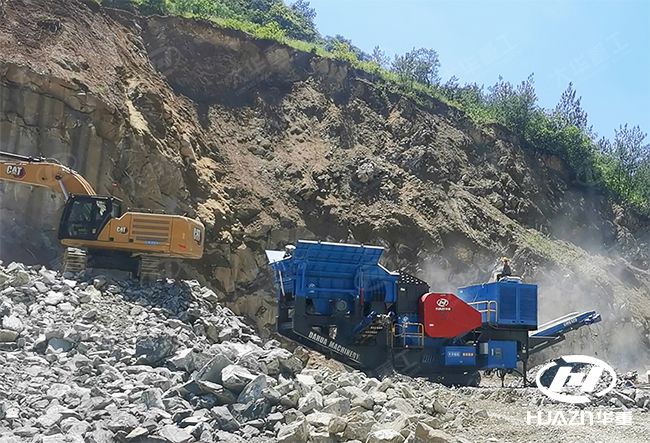
Based on the different walking devices, mobile crushing stations are mainly divided into two categories: wheeled and tracked. Wheel-mounted mobile crushing plants, built on semi-trailer chassis, are short in length and have a small turning radius, allowing for flexible movement on ordinary roads. They are suitable for flat roads and highway relocation, offering low cost and high performance. Typically equipped with an onboard feeder and vibrating screen, they can process 50-500 tons per hour and are widely used in sand and gravel aggregate production, earthwork engineering, and other scenarios.
Tracked mobile crushing plants, on the other hand, use hydraulically driven tracks, have low ground pressure, and can climb slopes up to 35°, adapting to complex terrains such as mud and gravel. They can move autonomously without external towing. They are particularly suitable for complex working conditions such as mining and post-disaster reconstruction, allowing direct entry into the work site and rapid commencement of crushing operations. However, long-distance relocation of tracked mobile crushing plants requires flatbed transport, resulting in relatively higher costs.
Besides being classified by their walking mechanism, mobile crushing plants can also be categorized by the type of crushing unit, such as jaw crusher mobile plants, impact crusher mobile plants, cone crusher mobile plants, and sand making mobile plants. Jaw crusher mobile stations are used for coarse crushing, handling large materials such as granite and limestone; impact crusher mobile stations are used for medium and fine crushing, producing good particle shape, suitable for construction waste and soft rock processing; cone crusher mobile stations are designed for fine crushing of high-hardness stones, with high output and low wear; sand making mobile stations integrate impact crushing and screening, enabling on-site sand production to meet the sand needs of large-scale projects.
III. Development Direction of Intelligent and Green Development
With continuous technological advancements, mobile crushing stations are rapidly developing towards intelligent and green development. In terms of intelligent development, technologies such as 5G remote control and digital twins will be further integrated into equipment operation. Operators can centrally control and schedule multiple mobile crushing stations through a remote platform, even completing operations such as starting and stopping equipment and adjusting parameters from the office, significantly reducing on-site personnel input and improving operational safety. Digital twin technology can build virtual models of the equipment, simulating the equipment's operating status in real time, predicting faults in advance, and achieving preventative maintenance.
In terms of green development, mobile crushing stations will place greater emphasis on energy conservation and environmental protection. New hydraulic drive and load-sensitive control technologies further reduce equipment energy consumption; integrated dust and noise reduction systems effectively reduce dust and noise pollution during operation, meeting increasingly stringent environmental protection requirements. Simultaneously, the equipment's recyclability will be improved, with greater use of recyclable materials, reducing the environmental impact throughout its entire lifecycle.
Mobile crushing plants, with their unique technological advantages, are reshaping the industry landscape of crushing operations. They are not only highly efficient crushing equipment but also a flexible resource processing solution, playing an irreplaceable role in promoting green mine construction, construction waste recycling, and rapid infrastructure construction. With continuous technological iteration and upgrades, mobile crushing plants will undoubtedly inject a constant stream of new momentum into the high-quality development of the industry.
Previous Article:No Information
Next Article: The Process Flow and Price of Ore Crushing Production Line