Product Knowledge
How Much Does a 500-ton-per-hour Sand Making Production Line Cost?
author:dahua2 time:2026-11-19
A sand making production line typically consists of core modules for conveying, primary crushing, secondary/tertiary crushing, and sand-making and screening. In current industry practice, a jaw crusher is generally used for primary crushing. For secondary and tertiary crushing, equipment such as cone crushers or impact crushers can be selected based on the specific characteristics of the raw material. An impact-type sand-making machine is the primary choice for sand shaping, while vibrating screens are used for classification, and vibrating feeders are employed for material intake. The entire process is linked by a series of belt conveyors. For a production line with an hourly capacity of 500 tons, the total investment—depending on the configuration level and the type of material processed—typically ranges from $700,000 to $2 million USD. A standard, basic configuration may fall within the $600,000 to $1 million USD range, whereas an eco-friendly, intelligent system designed for hard rock can exceed $1.5 million USD.
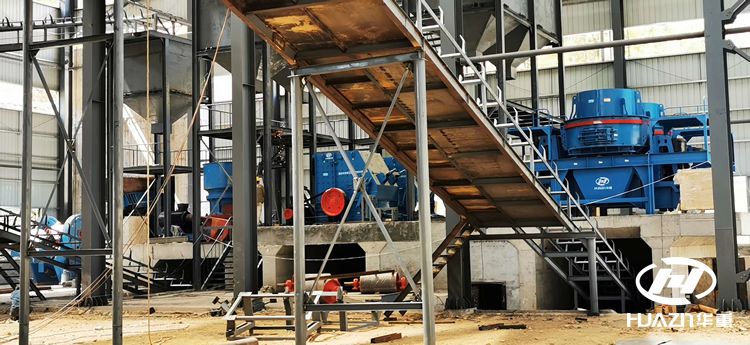
Reference for Configuring a 500-Ton-per-Hour Dry-Process Sand-Making Production Line
Because the physical hardness of various stone materials differs significantly, the required production line configuration varies depending on whether the material is of high, medium, or low hardness. Below are two proven configuration schemes tailored to common material types:
1. Configuration for High-Hardness or Medium-to-High-Hardness Stone
For high-hardness materials such as river pebbles, granite, or basalt, the crushing process places extreme demands on the wear resistance of the equipment. This production line configuration centers on a combination of a JC-series jaw crusher, a GPY/HPY-series cone crusher, and a PLS-series impact-type sand-making machine. A large-scale jaw crusher is used as the primary unit to handle large raw stones. The secondary stage utilizes a cone crusher—a machine specifically engineered for hard rock—which offers high capacity, exceptional efficiency in processing hard materials, and lower long-term operating costs. Following intermediate and fine crushing by a cone crusher, an impact-type sand-making machine is employed for further fine crushing and shaping. This process yields qualified manufactured sand with a particle size of less than 5 mm. The impact crusher also serves to shape the aggregate, ensuring that the final sand and gravel products have a rounded, high-quality particle shape.
The complete production process is as follows: vibrating feeder → jaw crusher → cone crusher → vibrating screen → impact-type sand-making machine → vibrating screening equipment. The entire operation utilizes a dry-processing method, eliminating the need for a separate washing stage. This not only saves a significant amount of water but also allows for the removal of excess fine powder via the vibrating screens, enabling precise control over the fine-powder content. The resulting high-quality sand and gravel aggregates fully meet the standards required for high-end concrete production.
2. Configuration for Medium-Hard and Soft Stone Materials
For softer stone materials with a lower Mohs hardness—such as limestone—the production line utilizes a core configuration consisting of a jaw crusher (or hammer crusher), an impact crusher (horizontal shaft), and a compound sand-making machine. A hammer crusher or jaw crusher serves as the primary crusher, while an impact crusher is used for secondary crushing; this setup offers a large feed opening, flexible adjustment of output particle size, and a high proportion of cubical-shaped particles. A compound sand-making machine is used for the final sand-making stage, offering superior fine-grinding capabilities and a more continuous particle-size distribution. Its screen-bar-free design prevents clogging, even when processing materials with high moisture or clay content.
The complete production process is as follows: vibrating feeder → hammer crusher → impact crusher → vibrating screen → compound sand-making machine → final screening → with oversized material returned to the compound crusher to form a closed-circuit loop. A sand-making production line with an hourly capacity of 500 tons is considered a large-scale operation. Determining the precise equipment configuration requires a thorough assessment of the specific operational environment—taking into account key factors such as raw material hardness, target production capacity, input and output particle size requirements, site conditions, and environmental compliance standards—to arrive at the most suitable, actionable solution.
Luoyang Dahua Heavy Industry is a direct-sales manufacturer integrating R&D, production, sales, and service. We offer a comprehensive range of high-quality, reliable mining and crushing equipment. Our team provides customized solutions by optimizing equipment combinations and developing tailored operational plans to meet diverse process requirements. We offer end-to-end support, covering everything from equipment selection and site assessment to manufacturing, installation, commissioning, and final handover. We invite you to visit Luoyang Dahua Heavy Industry for an on-site tour; our team is ready to provide you with professional expertise and support!
Previous Article:No Information
Next Article: What is the Difference Between a Modular Crushing Station and a Mobile Crushing Station?